Chelated Minerals vs Inorganic Minerals: Which Is Better for Livestock?
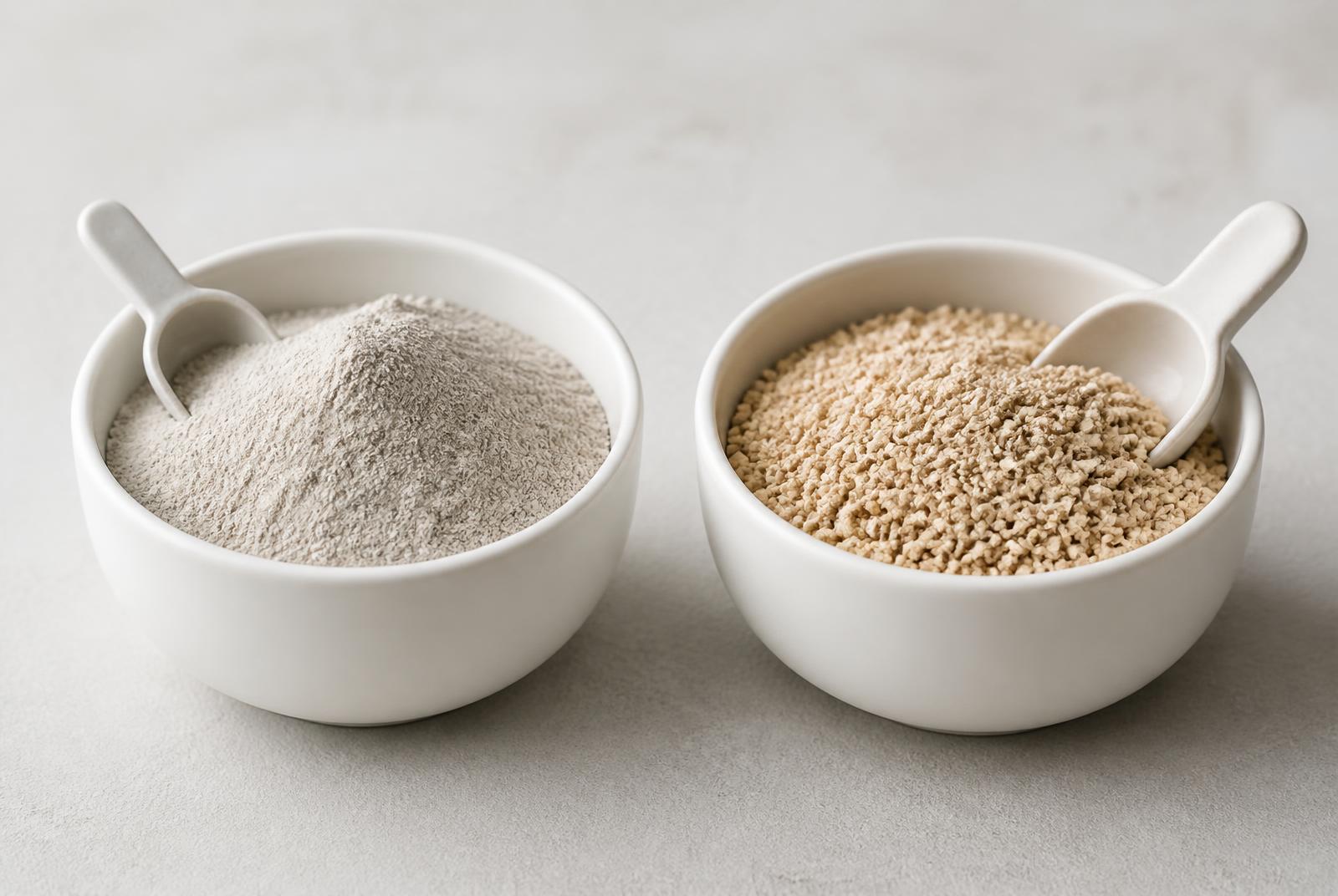
Two supplements can carry the same label percentage and deliver very different results. A practical comparison of absorption, bioavailability and the production outcomes that follow.
Introduction
Trace minerals — zinc, copper, manganese, iron, cobalt, selenium, chromium — make up a tiny share of the ration but control an enormous share of performance. They sit at the centre of immunity, hoof keratin, enzyme systems, hormone activity and reproduction. The question on most farms is no longer whether to supplement, but in which form: traditional inorganic salts, or chelated (organic) minerals.
Both forms declare the same mineral percentage on the label. What differs is how much of that mineral actually crosses the intestinal wall and reaches the tissue that needs it.
Mineral absorption: what happens inside the gut
Inorganic minerals — sulphates, oxides, carbonates and chlorides — dissolve in the rumen and stomach and release free metal ions. Free ions are chemically reactive, and the digestive tract is a crowded place, so a large share never reaches an absorption site.
- Antagonism: free zinc, copper, iron and manganese compete for the same intestinal transporters, so excess of one suppresses uptake of another.
- Binding: phytate in cereals and oilcakes, high dietary calcium, fibre, sulphur and molybdenum lock ions into insoluble complexes that pass out in the dung.
- Water quality: high sulphate, iron or hardness in borewell water further reduces the availability of inorganic copper and zinc.
- Rumen interference: free ions can also disturb rumen microbes and reduce fibre digestion at higher inclusion rates.
- Chelated minerals behave differently — the mineral is already bound to an organic ligand such as an amino acid, so it stays protected in a stable, neutral, soluble form through the gut and is absorbed largely intact.
Bioavailability: the number that matters
Bioavailability is the fraction of the supplemented mineral that is actually absorbed, retained and used. Inorganic trace mineral absorption is often in the range of 5–20 percent under practical field conditions; well-made chelates are consistently higher, which is why lower inclusion rates can deliver equal or better tissue status.
- Higher absorption means better liver and blood mineral status at the same or lower supplementation level.
- Lower inclusion means less mineral excreted in dung and urine — better for soil, water and long-term farm sustainability.
- Less free ion in the ration means less oxidation of vitamins A, D3, E and fats during feed storage.
- Stable chelates resist the pH swings of the rumen and abomasum, so delivery is predictable rather than dependent on ration composition.
Two mineral mixtures can show the same zinc on the label and differ by several fold in the zinc that ever reaches the hoof. Bioavailability, not declaration, is what the animal experiences.
Why glycine-chelated minerals improve nutrient utilisation
Glycine is the smallest amino acid, and that single fact explains most of the advantage. A mineral glycinate is a compact, low-molecular-weight, electrically neutral molecule — small enough and stable enough to be handled by the gut in a way larger complexes are not.
- Small molecular size: glycine chelates are among the smallest organic mineral forms, giving faster and more complete passage across the intestinal lining.
- Amino-acid transport route: they can be absorbed via peptide and amino-acid pathways rather than competing on the crowded metal-ion transporters, so antagonism between zinc, copper and iron largely disappears.
- High chelation stability: the ring structure holds the mineral securely at rumen and abomasal pH, so it is not released as a free ion to be bound by phytate, fibre or sulphur.
- Neutral charge: no ionic reactivity means no interference with rumen microbes and no oxidative damage to vitamins and fats in the premix.
- Dual nutrition: the glycine itself is absorbed and used — a small but real contribution as a building block for collagen, keratin and glutathione.
- Consistency: because delivery does not depend on ration antagonists, results are repeatable across different feed bases, soils and water sources.
Performance under stress conditions
Mineral form matters least when everything is going well and most when the animal is under pressure. Heat stress, transport, disease challenge, calving, weaning and high stocking density all raise requirement while cutting intake at the same time.
- Heat stress increases mineral loss through sweat and urine while dry matter intake falls — a higher-availability form covers the gap without raising inclusion.
- Zinc, copper, selenium and chromium support antioxidant enzymes (superoxide dismutase, glutathione peroxidase) that neutralise the oxidative load of stress.
- Better immune-cell function means fewer secondary infections around calving, weaning and transport.
- Chromium supports insulin sensitivity and helps maintain intake and glucose supply during heat and transition stress.
Milk production and milk quality
- Improved trace mineral status supports rumen fermentation and dry matter intake — the foundation of yield.
- Zinc strengthens teat-end keratin and udder immunity, typically reflected in lower somatic cell counts and fewer mastitis cases.
- Selenium and Vitamin E together reduce oxidative damage in udder tissue and improve milk shelf stability.
- Fewer clinical cases means less discarded milk and fewer withdrawal periods — often the largest financial gain of all.
Fertility and reproductive performance
- Zinc, manganese and copper are required for ovarian steroid synthesis, follicular development and clear heat expression.
- Selenium supports placental release — deficiency is a classic contributor to retained placenta.
- Better antioxidant status improves oocyte and embryo quality, reducing early embryonic loss and repeat breeding.
- In breeding males, zinc and selenium directly influence sperm concentration, motility and morphology.
- The practical outcome is a shorter interval to first heat, better conception at first service and a tighter calving interval.
Hoof health and lameness
Hoof horn is keratin, and keratin cannot be built without zinc, biotin, copper and manganese. Lameness is one of the costliest and most under-recognised losses in dairy and one of the clearest places where mineral form shows up in the field.
- Zinc and biotin harden the hoof horn and speed repair of the white line and sole.
- Copper cross-links keratin fibres, giving resistance to wet, muddy and abrasive flooring.
- Manganese supports cartilage and joint integrity, reducing stiffness in heavy animals.
- Sound hooves mean more time at the feed bunk — lame animals eat less, milk less and cycle later.
Feed conversion efficiency
- Trace minerals are cofactors for the enzymes of protein, carbohydrate and fat metabolism — availability directly influences nutrient utilisation.
- In poultry and swine, chelated zinc, copper and manganese are consistently associated with better weight gain and improved feed conversion ratio.
- Healthier gut lining means better nutrient absorption across the board, not only of minerals.
- Less mineral excreted per unit of output means a lower cost per litre of milk or per kilogram of gain, even when the chelate costs more per kilogram of premix.
So which is better?
Inorganic minerals are not useless — they are inexpensive and they meet basic maintenance needs where the ration is clean, water quality is good and production pressure is modest. The practical answer for most commercial farms is a combination: an inorganic base that covers bulk requirement, with the critical trace minerals supplied in chelated, preferably glycine-chelated, form.
- Choose chelated forms for high-yielding dairy animals, transition and fresh animals, breeding stock, fast-growing broilers and pigs, and any herd under heat or disease pressure.
- Prioritise chelation for zinc, copper, manganese, selenium and chromium — the minerals most damaged by antagonism.
- Match the mineral mixture to your area: local soil, fodder and water decide which deficiencies are real on your farm.
- Judge the product by outcomes over three to six months — somatic cell count, days open, lameness incidence and feed conversion — not by the label percentage alone.
Do not buy minerals by the kilogram. Buy them by what reaches the udder, the ovary and the hoof.
AlimentosX formulates area-specific mineral mixtures and chelated trace mineral supplements for cattle, buffaloes, horses, goats, sheep, poultry and swine, designed for high bioavailability under Indian feed and climate conditions. Speak to your veterinarian or our technical team to match a formulation to your herd and region.
Nutrition support
AlimentosX formulates calcium, mineral mixture, energy, liver and toxin-control solutions across liquids, powders, gels and boluses for every species covered here.
Explore products